
Mental Emotional Worksheet
This worksheet is to help you identify physiological and emotional stressors and implement targeted relief techniques to restore systemic balance.

Part 1: Key Stressor
Self-Assessment
This section is designed to help you assess where the greatest stressors are in your life and what to prioritize first
in balancing your stress response. All of these questions are formatted in a “Yes/No” style- keep track of how many “Yes” responses you have in each section
KEY STRESSOR: Blood Sugar Imbalance
Do you experience symptoms of hypoglycemia such as: dizziness, shakiness, or brain fog between or following meals?
Do you frequently miss or delay meals?
Do you frequently crave sugar or carbohydrates?
Do you consume excessive sugar or refined carbohydrates?
Are you diabetic or pre-diabetic?
Do you regularly consume alcohol or caffeine?
Are there any other unlisted issues related to blood sugar imbalances?
KEY STRESSOR: Mental & Emotional Stressors
Do you frequently experience anxiety?
Do you suffer from depression?
Do you suffer from mood swings?
Do you have difficulty getting motivated?
Do you frequently experience feelings of agitation, anger, fear or worry?
KEY STRESSOR: Sleep Cycle Disturbances
Are you experiencing problems falling asleep?
Are you experiencing difficulty staying asleep?
Are you not sleeping enough hours?
Are you not able to fall into a deep sleep?
Do you suffer from light cycle disruption or shift work issues?
Do you frequently feel drowsy during the day?
KEY STRESSOR: Inflammation
Musculoskeletal: Do you suffer from headaches, muscle, back or joint pain?
Gastrointestinal: Do you suffer from IBS, Crohn's disease or diverticulitis?
Dermatological: Do you suffer from hives, eczema, or psoriasis?
Respiratory: Do you suffer from asthma, bronchitis, seasonal allergies or hay-fever?
Auto-immune: Do you suffer from any autoimmune condition such as MS, lupus, RA?
Immunological: Do you suffer from food allergies, chronic infections, or frequent illness?
Self-Reflection
Are there any places in your body that hurt when you are in a particular place, around a certain person, or in a specific situation?
Any other symptoms or places in your body that you suspect are holding on to emotional energy?
Understanding Your Results: The "Rule of Three"
As you review your responses in the Self-Assessment, pay close attention to the density of your "Yes" answers.
The Threshold for Balance: If you answered "Yes" to three or more questions within any single category (Blood Sugar, Mental/Emotional, Sleep, or Inflammation), that section represents a significant stressor that is actively taxing your nervous system.
The human nervous system is designed to handle occasional spikes in stress, but when three or more issues persist in one area, your body enters a state of "chronic "defense." To achieve true systemic balance, these high-density areas must be addressed first. Think of these results not as a diagnosis, but as a prioritized roadmap: start your recovery by choosing tools from the toolkit that specifically align with your highest-scoring categories.
Part 2: Your Stress Relief Menu
Once you have identified your stressors, choose a technique below that feels good to do to bring your system back into balance.
The 4-Sided Breath (Box Breathing):
A Navy SEAL technique to reset the nervous system. Inhale for 4, hold for 4, exhale for 4, hold empty for 4. Tutorial: Box Breathing
Body Scanning:
A meditative practice of scanning your body from head to toe to identify and consciously release physical tension. Guide: How to Body Scan
Guided Meditation:
Using vocal guidance to shift your brain waves from a stressed (Beta) state to a relaxed (Alpha) state. Resource: Insight Timer
The Dump List:
A "brain dump" of every task, worry, or to-do. By getting it onto paper, you signal to your brain that it no longer needs to use energy "holding" the information.
Epsom Salt Baths:
High in magnesium, these baths help relax muscles and calm the nervous system through osmotic absorption. Benefits of Epsom Salts
Grounding (Earthing):
Placing your bare feet on the earth (grass, sand, or dirt) to balance your body's electron levels and reduce inflammation. Introduction to Grounding
Putting Your Feet Up:
Specifically "Legs Up the Wall" pose. This encourages lymphatic drainage and triggers the parasympathetic nervous system. Yoga Journal: Legs Up the Wall
The Inlightened Emotional Method:
The Inlighted Emotion Method is a technique developed by Dr. Jessica Fish. It is rooted in the philosophy that physical symptoms are frequently the body's way of "tucking away" unresolved emotional pain as a defense mechanism.
By identifying and releasing these "stuck" emotional stories, the physical symptoms can often be alleviated.
Core Principles of the Inlighted Emotion Method
The Emotional-Physical Connection: The brain may create physical distractions (pain, tension, or illness) to protect an individual from facing deep-seated emotional wounds.
Muscle Testing (Kinesiology): The method uses muscle testing to communicate with the body's innate wisdom. It helps determine if a symptom is strictly structural/nutritional or if it has an underlying emotional root.
Releasing the "Story": Once an emotion is identified, the method provides a framework to "untether" that story from the nervous system, allowing the energy to move through rather than remain stored in organs or muscles.
Application: It is often used by practitioners like chiropractors, massage therapists, and coaches to help clients with "hard to figure out" symptoms that don't respond to traditional structural treatments.
Where to Find It
You can find more information, practitioner training, and the 6-week self-guided course on the official website: Inlighted Method Official Website
Part 3: Your Personalized
Action Plan
Now that you have mapped your stressors, use this guide to prioritize your recovery. Don't try to do everything at once. Pick one "High Priority" tool based on your highest-scoring section from the questionnaire.
🚩 If your highest stressor was: Blood Sugar Imbalance
The Goal: Stabilize the "Physical Engine."
Immediate Step: Ensure you are eating protein and healthy fats with every meal.
The Tool: The Dump List. When blood sugar is unstable, the brain feels chaotic. Writing everything down prevents "decision fatigue" which can lead to poor food choices or reaching for caffeine/sugar.
The Habit: Try an Epsom Salt Bath in the evening to replenish magnesium, which is often depleted by high sugar intake and stress.
🚩 If your highest stressor was: Mental & Emotional Stressors
The Goal: Discharge the "Emotional Charge."
Immediate Step: Inlighted Emotion Method. On your next appointment, let’s identify if your current anxiety or mood swings are tied to a "stored story" in your body using the Inlighted Emotion Technique.
The Tool: The 4-Sided Breath. Use this the moment you feel agitation or fear rising. It is a "manual override" for your nervous system.
The Habit: Daily Guided Meditation (even just 5 minutes) to begin retraining your brain's response to emotional triggers.
🚩 If your highest stressor was: Sleep Cycle Disturbances
The Goal: Restore the "Circadian Rhythm."
Immediate Step: Putting Your Feet Up (Legs Up the Wall). Do this for 10 minutes before bed. It lowers the heart rate and shifts the body into "Rest and Digest" mode.
The Tool: Grounding. If you have shift-work or light-cycle issues, getting your bare feet on the earth for 15 minutes in the morning can help reset your internal clock.
The Habit: No screens 30 minutes before bed; replace that time with a Body Scan to drift off naturally.
🚩 If your highest stressor was: Inflammation
The Goal: Reduce the "Systemic Fire."
Immediate Step: Epsom Salt Baths. The sulfate and magnesium help pull toxins and reduce musculoskeletal pain.
The Tool: Grounding. Direct contact with the earth has been shown to reduce inflammatory markers and improve immune response.
The Habit: Combine The 4-Sided Breath with Body Scanning to identify exactly where the inflammation feels most "active" and consciously send breath to those areas.
Your 24-Hour Commitment
To get started, commit to one practice for the next 24 hours:
Which tool will you use? _________________________________________________
When specifically will you do it? __________________________________________
How do you hope to feel afterward? _________________________________________
Part 4: 7-Day Resilience Tracker
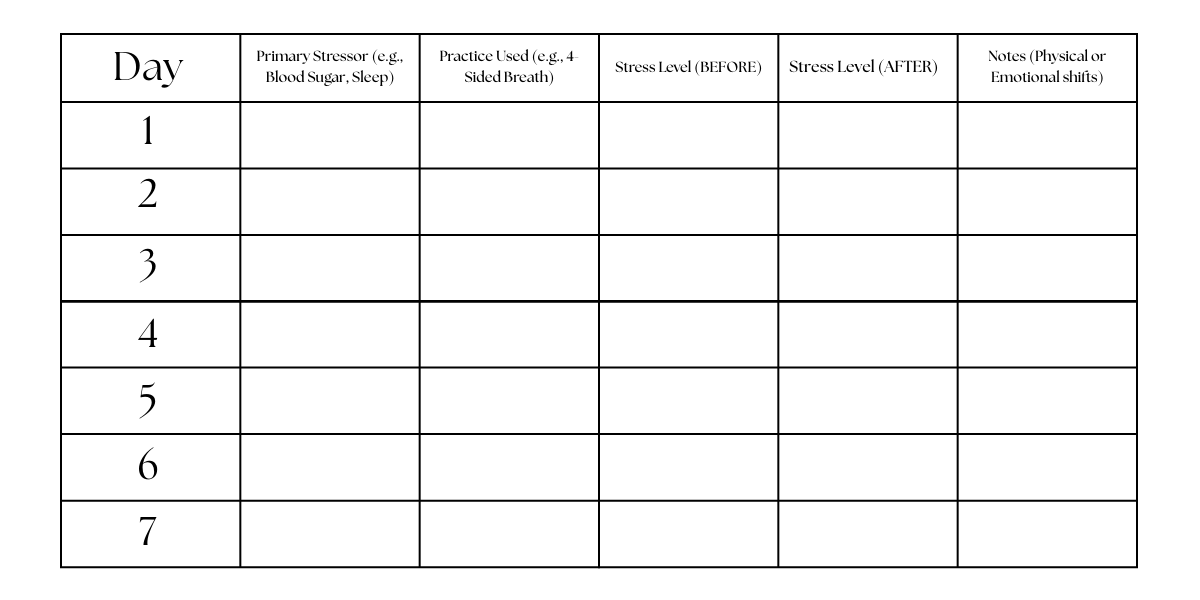
This tracker is a great way to help you see the "proof" that these methods work. Often, stress relief is subtle; by tracking their numbers, you can see the direct correlation between a practice (like Grounding) and a reduction in physical pain or anxiety.
Use this log to track your progress. Rate your Stress Level on a scale of 1–10 (1 = Zen, 10 = Crisis) immediately before and 15 minutes after your chosen practice.
Quick Reference: Body Cues
If you aren't sure which tool to pick in the moment, listen to your body's "Check Engine" lights:
Tight Jaw/Shoulders? → Body Scan or Epsom Salt Bath.
Racing Thoughts/Panic? → 4-Sided Breath (Box Breathing).
Heavy Legs/Swollen Ankles? → Feet Up the Wall.
Feeling "Unseen" or Stuck? → Inlighted Emotion Method.
Scattered/Can't Focus? → The Dump List.
Pro-Tip for Success:
The "Stacking" Method: Try stacking a practice with something you already do. For example, do your 4-Sided Breath while the coffee is brewing, or do your Dump List while you have your Feet Up the Wall. This makes the habit much easier to keep!
Part 5: My Long-Term Resilience Plans
Congratulations on completing this deep dive into your mental and emotional health. Use this page to summarize your findings and create a "Safety Net" for the future.
1. The "Early Warning" Signs
Looking back at your questionnaire and 7-day tracker, what are the first 2-3 signs that your system is becoming overwhelmed? (e.g., “I start craving sugar,” “my lower back aches,” or “I get snappy with my partner.”)
…..
2. My "Non-Negotiable" Daily Practice
Which single tool felt the most effective or easiest to integrate? This is your daily "baseline" to prevent stress from building up.
My Daily Practice: ____________________________________________________
Time of Day: __________________________________________________________
3. My Emergency "Circuit Breakers"
When life gets chaotic and you don't have time for a full bath or a long meditation, which 30-second tool will you use to break the stress response?
[ ] 3 Rounds of 4-Sided Breath
[ ] 1 Minute of Grounding (stepping outside)
[ ] A 10-item Dump List
Final Review:
The Mind-Body Connection
Remember that your body is a feedback loop.
If your body is inflamed, your mind will feel anxious.
If your blood sugar is low, your emotions will feel volatile.
If your emotions are stuck, your muscles will feel tight.
By using the Inlighted Emotion Method alongside physical resets like Epsom salts and Grounding, you are treating yourself as a whole system rather than a collection of symptoms.
"The greatest act of self-care is not a one-time event, but the consistent awareness of what my body is trying to tell me."